
How do you know which drivers need coaching, and what they should work on?
Without a consistent way to evaluate driving records, it can be difficult for safety teams to determine where attention is needed most. MVR scoring gives your team a consistent way to evaluate driving records against your company’s risk criteria, helping you prioritize reviews and identify coaching needs.
But identifying where attention is needed is only the beginning. How can your team turn MVR scores into focused, effective driver coaching?
What Is MVR Scoring?
An MVR score is a safety metric that enables managers to evaluate driver performance based on driving history and risk level. It considers factors such as violation severity, frequency, and recency, along with license suspensions or other actions. The resulting score helps your team identify potential policy concerns, prioritize driver reviews, and determine when coaching or corrective action may be needed.
MVR scoring makes reviews more consistent by applying the same risk criteria to every driver’s record, reducing reliance on individual judgment.
How Our MVR Scoring Tool Works
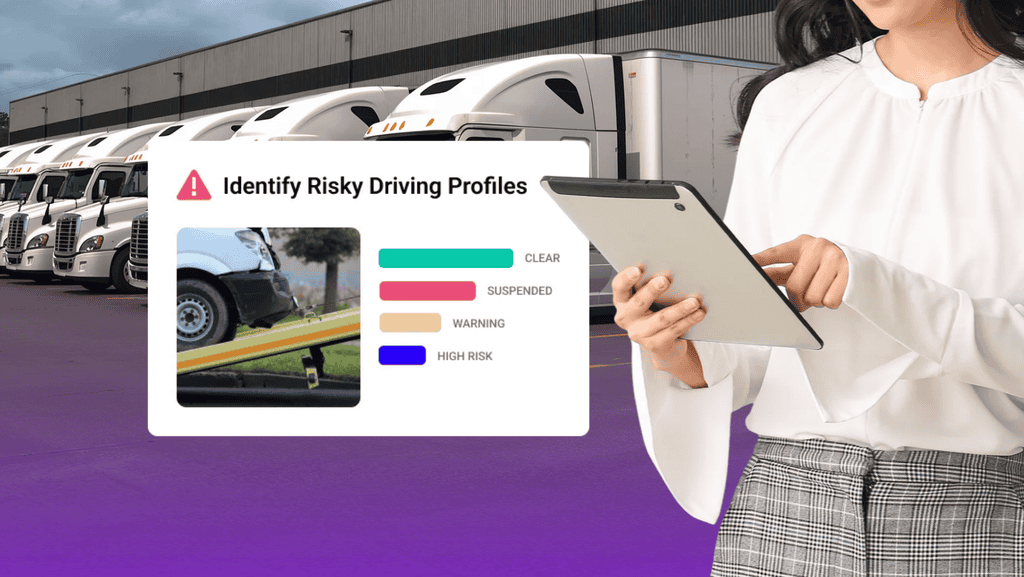
Our MVR Monitoring platform offers an easy-to-use, color-coded MVR scoring system to help your team quickly identify drivers who need attention. Each color communicates the status of a driver’s record without requiring your team to interpret a numerical point total.
- Green score: All clear—your driver’s MVR shows no new violations.
- Yellow score: Your driver’s MVR shows a new violation. You can further customize yellow scores based on your company’s criteria.
- Red score: The driver’s license is suspended, expired or revoked and requires immediate attention.
Customization can include flagging specific violations, such as distracted driving, or applying stricter criteria to drivers on probation who need closer oversight.
How MVR Scoring Helps Identify High-Risk Drivers
Identifying higher-risk drivers starts with a clear driver safety policy. Define how violations, incidents, and license issues affect eligibility to drive based on your organization’s safety standards and risk tolerance.
Not all violations carry the same weight. A single minor violation may warrant a different response than repeated speeding violations, a serious offense, or several incidents within a short period.
MVR scoring helps your team spot drivers whose records fall outside your company’s risk criteria. By considering violation severity, frequency, and recency, scores can highlight:
- Serious violations that may require immediate review or removal from driving duties.
- Repeated violations that suggest a pattern of risky driving.
- Recent violations that may warrant closer attention.
- Critical driver license status changes
Establishing consistent scoring criteria helps fleet managers evaluate drivers more objectively and apply the organization’s policies consistently.
Read more: How to Conduct a Fleet Risk Assessment?
How MVR scoring supports driver coaching
When a driver’s score flags a potential risk, review the violations behind it. Understanding those violations helps your team choose the right coaching or training to address specific driving behaviors. For example:
- Repeated speeding violations may point to a need for speed management training.
- Distracted driving violations may call for coaching focused on eliminating distractions behind the wheel.
- Following-too-closely violations may indicate a need for training on safe following distance and defensive driving.
This approach allows safety teams to focus coaching on the specific behaviors reflected in the driver’s record rather than assigning the same training to every driver.
MVR scoring should help prioritize attention, while the underlying driving history helps guide the appropriate response.
From MVR Scores to Action: Strategies for Driver Coaching
An MVR score can help identify drivers who may require additional attention, but the next step is understanding what is driving that score. Use the score alongside the driver’s MVR to determine the appropriate response.
- Identify Drivers Who Need Attention: Review MVR scores to flag drivers who may present a higher level of risk. Prioritize those whose scores indicate greater concern for further evaluation.
- Review the Violations Behind the Score: Examine the driver’s MVR to understand which violations contribute to the score. Consider their type, severity, and frequency to determine the specific driving behaviors that require attention.
- Review the Driver Qualification File (DQF): While reviewing a flagged driver, fleets can also use the opportunity to verify qualification records and address any separate compliance gaps.
- Determine the Appropriate Action: Based on the MVR findings and DQF review, determine whether the driver needs targeted coaching, additional training, or corrective action. Address any outstanding qualification or documentation issues separately.
- Monitor Progress and Reassess Risk: Continue monitoring MVR records for new violations and changes in the driver’s risk profile. Evaluate whether the actions taken have addressed the identified concerns and determine whether further intervention is necessary.
Make MVR Scoring Part of Your Driver Safety Strategy
MVR scoring gives organizations a more consistent way to evaluate driver risk and determine where additional attention may be needed. The goal is to utilize scoring to better understand driver risk, apply company policies consistently, and support a more proactive safety program.
MVR Online brings MVR monitoring, customizable scoring, and driver training together, helping your team identify changes and take corrective action in one platform. Schedule a demo to learn more about our safety solutions.
Frequently Asked Questions
*We are not lawyers. Consult with your legal counsel to ensure your processes and procedures meet/ or exceed safety standards and compliance regulations.